
Understanding Tennessee’s Recent Special Session
On May 5, 2026, the Tennessee General Assembly convened or came together for a Special Session. This Special Session was called by Tennessee Governor Bill Lee as a response to the recent Supreme Court Decision, Louisiana v. Callais. As a result of the Special Session, U.S. congressional districts were redrawn.
This is a plain language overview of:
Part 1: Tennessee’s May Special Session
Part 2: Supreme Court Decision – Louisiana v. Callais
Part 3: The Voting Rights Act of 1965
Part 4: DRT’s Voting Program and Resources
Part 1: Special Session
What is a special session?
A special session is when lawmakers are called together outside of their regular schedule to focus on a specific issue. A special session in Tennessee can only be called by the governor. This is written in Article 3, Section 9 of the Tennessee Constitution.
Article 3, Section 9:
The governor “may, on extraordinary occasions, convene the General Assembly by proclamation, in which he shall state specifically the purposes for which they are to convene; but they shall enter on no legislative business except that for which they were specifically called together.”
Plain Language Explanation:
The governor can call a special meeting of the legislature (the Tennessee General Assembly) when someone important or unusual comes up.
When a special session is called, the governor must say exactly why they are calling the meeting.
During a special session, lawmakers can only work on the topics listed by the governor in the proclamation, or announcement, nothing else. It is important to note that special sessions can also be called extraordinary sessions.
This is not the first time Tennessee has called a special session. Some recent examples of a special session in Tennessee are:
The May 2026 Special Session
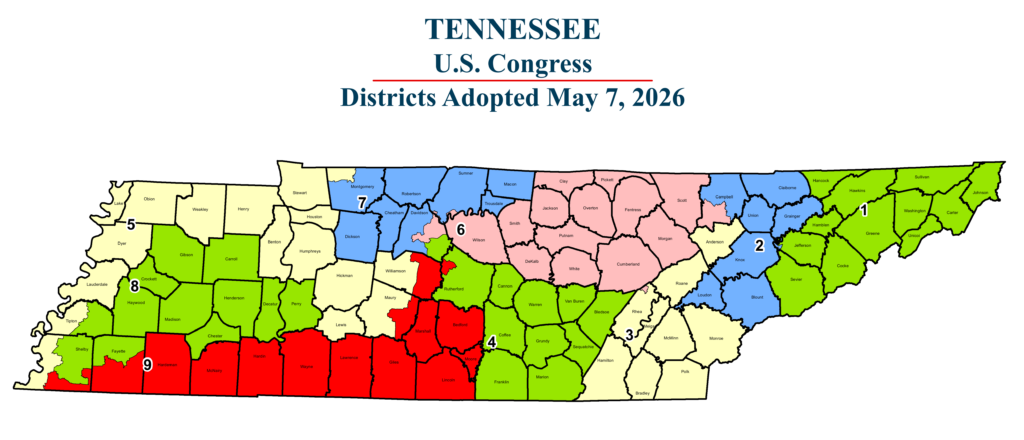
On May 1, 2026, Governor Bill Lee called a special session of the Tennessee General Assembly. State lawmakers met from May 5-7, 2026, to review (and redraw) the state’s U.S. congressional map. Each state is divided into smaller areas called voting districts, which help make sure each person’s vote counts the same. These district lines are updated every 10 years after the U.S. Census to reflect changes in population. The purpose of the special session was to determine whether Tennessee’s current maps are fair, legal, and accurately reflect voters. Read Governor Lee’s full proclamation by clicking here.
The special session was tied to recent nationwide attention on congressional representation as was seen in the Supreme Court decision, on the Louisiana v. Callais case, released on April 29, 2026. More on that case is below.
As a result on the 2026 Special Session, U.S. Congressional districts in Tennessee were redrawn and Memphis was divided into three separate districts. You can learn more on the Tennessee Secretary of State’s website by clicking here.
Part 2: Louisiana v. Callais
History of the case:
In January 2023, the state of Louisiana changed its voting map to include two districts where most voters are black. This happened after a court said that the state of Louisiana needed to create fair representation under Section 2 of the Voting Rights Act. This part of the law says voting rules cannot discriminate based on race or color.
Later, in January 2024, a lawsuit was filed saying the new map was unconstitutional. The claim or reasoning was that the map used race in an unfair way, which is sometimes called racial gerrymandering.
Quick 101 on Gerrymandering: Gerrymandering is when voting district lines are drawn in a way that gives one group or political party an unfair advantage. This can weaken the power of some people’s votes.
For example, if one district is drawn so that one group always outnumbers another, the smaller group’s votes may not matter as much.
The Louisiana v. Callais Decision
The U.S. Supreme Court heard this case and made a decision in April 2026.
The question was whether Louisiana was allowed to create a second district with mostly Black voters to follow the Voting Rights Act. The Court said the Constitution does not allow race-based district drawing unless there is a very strong legal reason.
The U.S. Supreme Court decided Louisiana could not use race to create a second Black-majority district, saying it was not justified in this case.
Read more about the decision and everything that went into the decision here. *Please note, some of the information on this site are not written in plain language.
What does this mean for you?
The U.S. Supreme Court’s decision in Louisana v. Callais may lead other states to review and update voting district lines. When district lines change, it can affect where you vote, which district you live in, and who represents you.
Even if you do not live in an area where districts were recently redrawn, it is still important to check your voter information before each election. Polling locations can change, and your district or ballot may look different than it has in the past.
For people with disabilities, having clear and accurate information is especially important to make sure voting is accessible and goes smoothly. These changes are a reminder to stay informed and to know your rights as a voter.
This is where the Voting Rights Act and Disability Rights Tennessee’s work come in. DRT helps people with disabilities understand their voting rights, check their registration, and find the information they need to safely and confidently take part in elections.
Part 3: The Voting Rights Act of 1965
The Voting Rights Act is a federal law passed in 1965 to protect people from discrimination when voting. It is legislation that plays a big role in many of the issues being discussed here in this blog.
What does the law do?
Stops unfair voting rules: Outlaws tests or rules (like literacy tests) that were used to keep people from registering or voting.
Protects language access: Helps voters who speak languages other than English, including Spanish, Native American languages, and many Asian languages, get help and voting materials.
Protects fair representation: Stops voting maps from being drawn in ways that weaken the voting power of racial or language minority groups (like splitting them up or packing them into one area).
Checks changes to voting rules: Required some places with a history of discrimination to get federal approval before changing voting laws, to prevent new barriers.
While it was originally created to address racial discrimination, it also helps protect the voting rights of people with disabilities. The law supports equal access to voting by allowing voters with disabilities to get help from a person they choose, use accessible voting equipment, and vote without unfair barriers. It also protects against practices that make it harder for people to register, cast a ballot, or have their vote counted.
While laws like this set important protections, voters can still face real barriers. That’s where Disability Rights Tennessee comes in.
Part 4: DRT’s Voting Program and Resources
How Disability Rights Tennessee Can Help Voters
Disability Rights Tennessee (DRT) is the Protection and Advocacy (P&A) agency in Tennessee. This means we work to protect the rights of people living with disabilities, and this includes the right to vote. Through a federal program called PAVA (Protection and Advocacy for Voting Access), DRT helps makes sure voting in our state is accessible at every step.
What does this look like in real life?
Checking polling places for accessibility
We visit polling sites across Tennessee to look for potential barriers. Some examples of this are steps without ramps, confusing layouts to get from the parking lot to the voting booth, or voting machines that are hard to use. DRT works together with local and state officials to fix them.
Sharing information with voters
We help people with disabilities understand their voting rights, how to register to vote, and what to expect when voting early or on Election Day.
Training election staff
We provide guidance to poll workers on how to support voters with disabilities, including respectful communication and reasonable accommodations.
Helping Tennesseans solve problems
If someone has trouble registering or voting, we can provide support, answer questions, and help address the issue.
Working toward better systems
We partner with state and local officials to improve voting systems so they meet federal accessibility standards and work for everyone.
While DRT can help address barriers and advocate for change, our voting access work focuses on education, outreach, and problem-solving. This does not include legal action.
Need Help or Want to Connect?
You can reach out to DRT 24/7. All requests for help are reviewed during agency business hours (8:00 am-4:30pm CST/9:00 am-5:30 pm EST). Contact DRT by voice call/text at 1-800-342-1660, by email at GetHelp@DisabilityRightsTN.org, or by online form at www.DisabilityRightsTN.org/Get-Help/
Stay In Touch
Click here to sign up for our monthly newsletter.